Investigation vs. Mystery
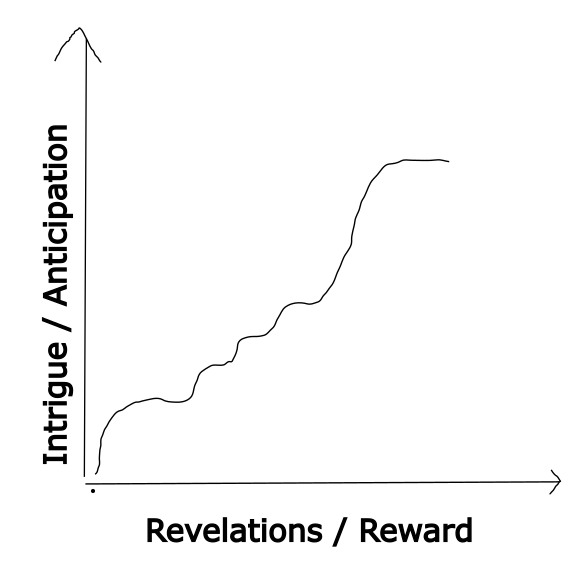
Mysteries are fictional constructs. In the real world we occasionally point to some fact unknown and call it a mystery, but this is us just trying to cram messy reality into our story boxes. Really, mysteries are form of interactive fiction. The reader is invited to find the solution to a question. In the ideal form, this playful engagement with the text provides a cresting rises of excitement as uncertainty and intrigue mounts and then elements of the solution resolve. If you go to the effort to hold the "clues" in your head, you are "rewarded" with revelations. Right at the very end, the reader fully uncovers the solution, exactly as the author designed. That's the simplified ideal, anyway.
The basic form follows an common step-like anticipation and reward curve. Entertainment of all types and especially games make use of them. Yet, mysteries are their own craft and art. While it's not rocket science (anyone can learn how to rip off Agatha Christie) it's not trivial. (It will take real effort to rip off Agatha Christie). And it's tricky to do mysteries in non-linear formats, though plenty of people have done exactly that.
When it comes to TRPGS, I would never discourage a GM from running a mystery, but I wouldn't encourage it either. I think most GM's are better off making things mysterious without worrying too much about crafting an immaculate anticipation curve for the "solution." Who says you need a solution anyways?
Investigations
Investigations are a broader concept and are easier to apply to both the real world and TRPGs.
Investigations are simply the gathering of intelligence on a particular case. There is no "solution" to an investigation. There is only an increasing amount and clarity of information.1
Investigations have some features that make them useful to TRPGs. They can broadly be split into three phases, collection, analysis and action.
Collection
Investigations need resources: money, time, manpower, access, specialized equipment. The player characters need to think about how these are committed to the investigation.
There are always more targets for collection than you have resources. Say you're investigating a senator for corruption. He has a wife, 2 kids, a mistress, a secretary, and a housecleaner. Who do you surveil?
Collection is imperfect, you can always devote more of your limited resources to investigate a target more thoroughly. Do you surveil the senator 24 hours a day, for how long? Do you tap his phone too? Bug his car?
This is logistical play that requires players to make judgements about how valuable future intelligence might be, based on what they know already. It's a good mix of accounting, world comprehension, and empathizing with NPC psychology.
In the most basic form, the party only has so much stamina and time to follow up on leads. So they must prioritize where they physically travel. In the worst case there is one and only lead.2 It's better if there are a few. It's even better if the players have other resources than only their personal attention to devote to the investigation. Real life investigations are sprawling affairs that might require entire departments. Try to give enough fuel and complexity so that 3-5 players can contribute.
Then comes the exciting part, actually doing the detective (or spy, or criminal, or journalist) thing. Which is made more meaningful and exciting by the logistical choices prior.
At this point investigations should be broken down into specific playful verbs. Never just "find out," always the specific action(s) that must taken in order to "find out." The specific actions will inform which resources need to be committed.
- Surveil the branch manager
- Break into the morgue
- Interrogate the ambassador's driver
- Wiretap the hotel phones
- Bribe the senator's housecleaner
Once it is collected intelligence has an expiration date. Older intelligence is less reliable, secure and useful. This motivates players to quickly collect and act on intelligence. It relates back to time as a resource in investigations. And it will nicely tie in with dynamic scenarios which evolve over time.
Analysis
Intelligence needs analysis. Collection will give you names, addresses, dates, documents, messages, testimonies, items. But it can't tell you what to think about that stuff. Analysis might simply be reviewing everything that has been collected and deciding if any of it is evil, or illegal, or just something you want to steal.
More complicated analysis asks the players decide on the credibility of each piece of intelligence and synthesize the most probable picture of what is going on. Players sometimes hesitate to do the synthesis part. A client or boss type NPC can demand the players at least try and put together a brief. However, it's fine to just free ball it and let the players stumble along with only whatever conclusions they've drawn in their own heads.
Action
Intelligence informs action. Once you've collected and analyzed the intelligence, it's time to decide what to do with it. At the start of the investigation, the party didn't necessarily need a well defined goal. It's enough to say "there's something shady going on at this company," or "there might be something valuable to steal in this place." By the end of the investigation, the players should have what they need to decide on a goal, like "capture the ambassador," and the means to formulate a plan. Sometimes the goal might be additional investigation. In order to capture the ambassador, you might need to collect a pattern of life and case the consulate.
Intelligence can be bought and sold. Intelligence, even if it isn't directly relevant to the players, is always potentially useful. Interested buyers can be found for anything that took effort to uncover. There are brokers in your world who specialize in finding the right buyers. There exist people in the world who do this sort of intelligence work "freelance," (so your player could also work freelance). Or an agent might have a particular handler who tasks them with collection on targets in exchange for cash and prizes.
You might pass on raw collection, like an agent to their handler. Or you might pass on the analyzed brief, (perhaps with a little bit of collection as proof) which protects your collection methods and sources. This is a good incentive for player to do the analysis step!
Players can investigate whatever seems interesting, and plausibly exchange it for money, or for intelligence for a different investigation. It's a flexible and infinitely extensible framework.
Examples
Two games that get it are Tom Bloom's CAIN and Luke Gearing's The Big Squirm (for Troika!).
In CAIN, the exorcists are simply tasked with locating the lair of a psychic monster and learning about the psychology of the target who's unconsciousness spawned it. While this can function as a mystery, it's much easier to run as an open ended investigation. There is no explicit reward for "solving the mystery" of the case. It's just a matter of collecting intelligence so that the mission can be completed.
In The Big Squirm, there is something resembling a mystery at the center, but players will probably not find themselves making many "aha!" deductions. Instead, they'll probably be led down lots of twisting dead ends and stumble over incomplete intelligence. But this is not in vain! Among these dead ends and half-finished puzzles are facts (collected intelligence). Each fact uncovered has value and can be traded for cash or other facts. At the end of the investigation, the players will have enough information to do something productive, even if that's just walking away with spending money in their pockets.
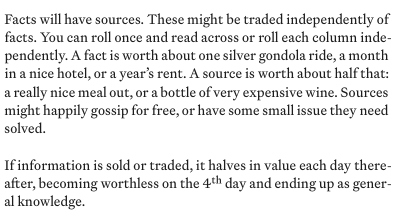
There are 19 "facts" in the Big Squirm that can be found at random. Of course, nothing is stopping the players from sourcing and selling their own facts. I love that The Big Squirm models the value decay of intelligence as well.
Conclusion
Unless you're committing to the form of the mystery for its own sake, focus on running investigations instead.
Investigations are ultimately not that different from the challenge based gameplay found in exploration based adventures, (such as a dungeon crawl). You could read the essay above as simply a restatement of Information, Choice, Impact. The investigation as a whole follows that framework, as well as in miniature at the collection and action steps.
You might investigate in service of a mystery. But the investigation will not deliver the solution itself. The solution to a mystery is the "eureka!" deduction/revelation moment combined with the clear validation of it's correctness. That's not how an investigation works. At best, in an investigation you can form a hypothesis and try to confirm it. When you're right it is similar to a eureka deduction, but it is different in method and justification. Think the scientific method vs. a puzzle.↩
Anal Bead Adventure Design, while not bad in and of itself, makes for a rote and boring investigation.↩